

Policies, Processes and SOPs:
What Is the Difference?

Anastasia Ivanovskaya
29 July, 2026
Across Saudi Arabia, the United Arab Emirates, Qatar, Jordan, Kuwait, Oman and Bahrain, companies are expanding, restructuring and introducing new technologies. Yet many organisations still rely on informal instructions, outdated documents or individual employees to explain how work should be done. As a business grows, this creates operational risk. Employees interpret requirements differently, approvals become inconsistent, responsibilities overlap and important tasks depend too heavily on personal knowledge.
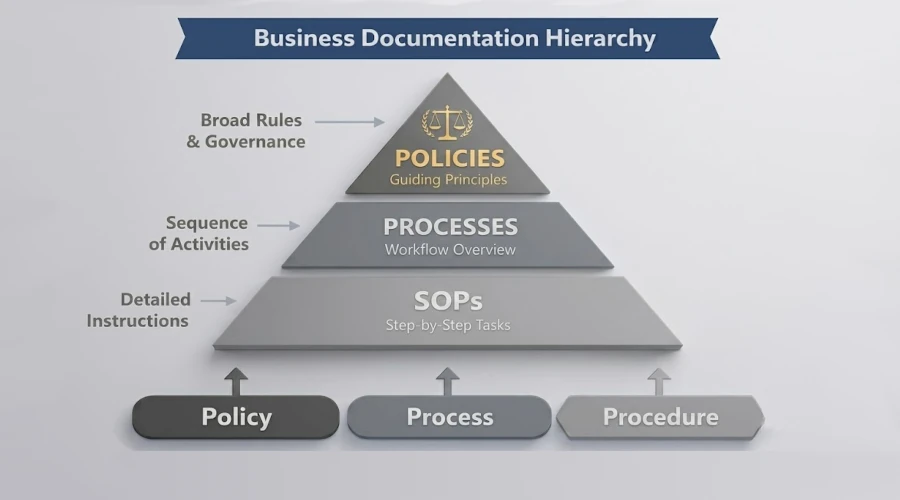
This is where policies, processes, procedures and standard operating procedures become essential. The terms are often used interchangeably, but they do not describe the same level of organisational documentation. A policy sets the rules and boundaries. A process shows how work moves from beginning to end. A procedure explains how a defined part of that process is carried out. An SOP provides standardised instructions for work that must be completed consistently.
Policies define what the organisation expects, processes explain how work flows and SOPs show employees exactly what to do.
Understanding the difference helps companies improve governance, reduce operational risk and create more consistent ways of working.
What Are Policies, Processes and SOPs?
A policy is a formal statement that defines the organisation’s position, rules or expectations. It provides direction for decision-making and establishes boundaries employees should follow.
Policies usually answer questions such as:
- What is permitted or prohibited?
- Who has authority to make a decision?
- Which standards must employees follow?
- What principles guide the organisation?
Examples include recruitment policies, leave policies, procurement policies, data-protection policies, expense policies and disciplinary policies.
A process describes how a business activity moves from beginning to end. It shows the sequence of activities, the departments involved, the responsibilities assigned and the decisions required at each stage.
Processes usually answer questions such as:
- Where does the work begin?
- Which departments or employees are involved?
- What happens at each stage?
- Where are approvals required?
- What is the final output?
Examples include recruitment processes, employee onboarding processes, procurement processes, payroll processes and customer complaint processes.
A procedure explains how a defined activity or part of a process should be carried out. It may describe responsibilities, decision points, approvals, controls, exceptions and the sequence of work. A Standard Operating Procedure, or SOP, is a formally approved procedure used to standardise recurring work. Depending on the organisation, an SOP may provide detailed task instructions or may cover a broader operational activity.
SOPs commonly answer questions such as:
- What is the purpose and scope of the activity?
- Who is responsible for performing, reviewing and approving the work?
- Which steps and controls must be followed?
- Which systems, forms, equipment or templates should be used?
- What should happen when an exception or emergency occurs?
- How should completion, approval or escalation be documented?
Examples include how to create a new employee record, approve an invoice, inspect a machine, prepare a monthly report or respond to a customer complaint.
The exact terminology varies between organisations. Some companies use procedure and SOP as interchangeable terms. Others use "procedure" for a broader activity and "SOP" for more detailed, standardised instructions. The organisation should define its document hierarchy and apply it consistently.
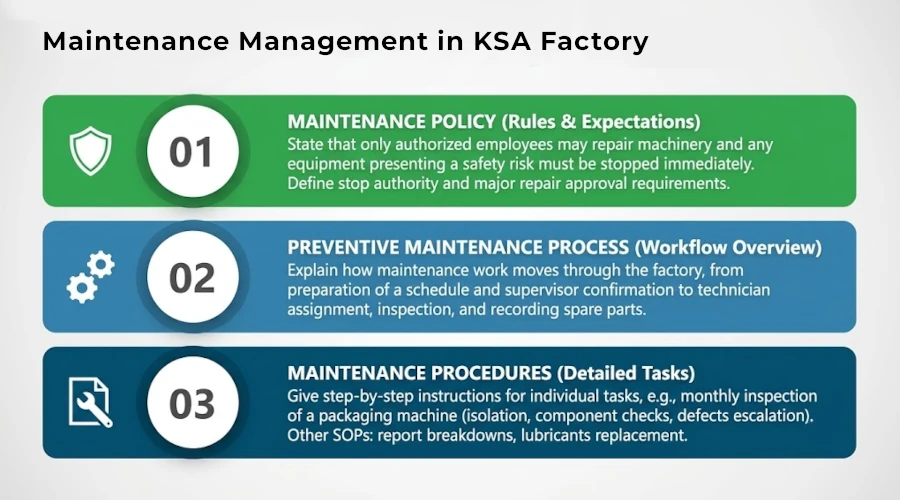
Example: Maintenance Management in a Saudi Factory
Consider a manufacturing company in Saudi Arabia operating several production lines. Its maintenance policy may state that all machinery must follow an approved maintenance schedule, only authorised employees may perform repairs and any unsafe equipment must be stopped immediately. The policy sets the rules, responsibilities and approval authority.
The preventive maintenance process explains how the work moves through the factory. Maintenance prepares the schedule, production confirms when the machine can be stopped, a technician completes the inspection or repair and the supervisor approves the machine’s return to operation. This process coordinates production, maintenance, procurement and management.
A maintenance SOP gives the technician detailed instructions for a specific task, such as inspecting a packaging machine. It may list the required protective equipment, isolation steps, components to check, measurements to record and defects that require escalation. In this example, the policy sets the rules, the process defines the workflow and the SOP explains exactly how the task should be completed.

The Main Differences Between Policies, Processes and SOPs
The main difference is the level of direction and detail each document provides.
Policies operate at the highest level. They define organisational rules, principles and expectations. They should remain relatively stable and normally require approval from senior management, the board or an authorised governance body.
Processes operate at the workflow level. They show how activities move across functions and clarify the relationship between employees, departments, systems and approvals.
SOPs operate at the procedure or task level. They standardise how recurring work should be carried out. Some SOPs focus on one detailed task, while others cover a broader operational procedure involving several related steps.
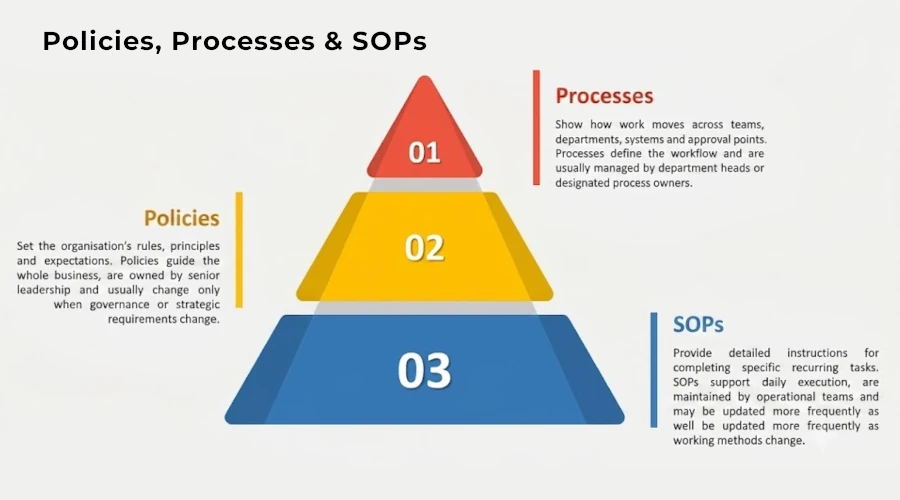
The differences can be summarised as follows:
Purpose: A policy provides direction, a process defines workflow and an SOP provides instructions.
Level of detail: Policies are broad, processes are structured and SOPs are detailed.
Primary users: Policies guide the whole organisation, processes guide teams and departments and SOPs guide employees performing specific tasks.
Ownership: Policies are often owned by senior management or functional leadership. Processes are usually owned by department heads or process owners. SOPs are maintained by the teams responsible for daily execution.
Frequency of change: Policies should not change unnecessarily. Processes may be updated when workflows, systems or responsibilities change. SOPs may require more frequent revision because they contain operational details.
A policy without a process may be difficult to implement. A process without an SOP may still leave employees uncertain about how to complete the work.
How SOP Manuals Are Commonly Structured in the Middle East
In many organisations across the Middle East, clients use the term SOPs more broadly than its strict technical definition. When a company requests "SOP development", it may expect a complete operational documentation package rather than only step-by-step task instructions. This is also common in tenders and requests for proposals. A scope described as the development of an SOP manual may require the consultant to document policies, processes, procedures, responsibilities, approval authorities, controls, forms and supporting templates within one coordinated set of manuals.
Depending on the organisation and the tender requirements, an SOP manual may include:
- the governing policy or a reference to the relevant policy;
- the purpose and scope of the activity;
- definitions and applicable standards;
- roles, responsibilities and approval authorities;
- process maps and workflow diagrams;
- detailed procedures and operating instructions;
- controls, risks, exceptions and escalation requirements;
- delegation-of-authority or responsibility matrices;
- forms, records, checklists and supporting templates;
- document ownership, approval and revision requirements.
For this reason, clients may refer to the entire assignment as "preparing SOPs", even when the deliverables extend beyond individual operating procedures. Consultants should therefore clarify the expected document hierarchy, number of manuals, level of detail and approval requirements before defining the project scope.
Packaging these elements within one SOP manual does not make policies, processes and procedures identical. The policy establishes the governing rule, the process describes how work moves across the organisation and the SOP standardises how the work should be carried out. They may be presented together for practical use while remaining distinct components of the organisation’s management system.
Documents may be combined for practical use, but their governance purpose and level of detail should remain clear.
How Policies, Processes and SOPs Work Together
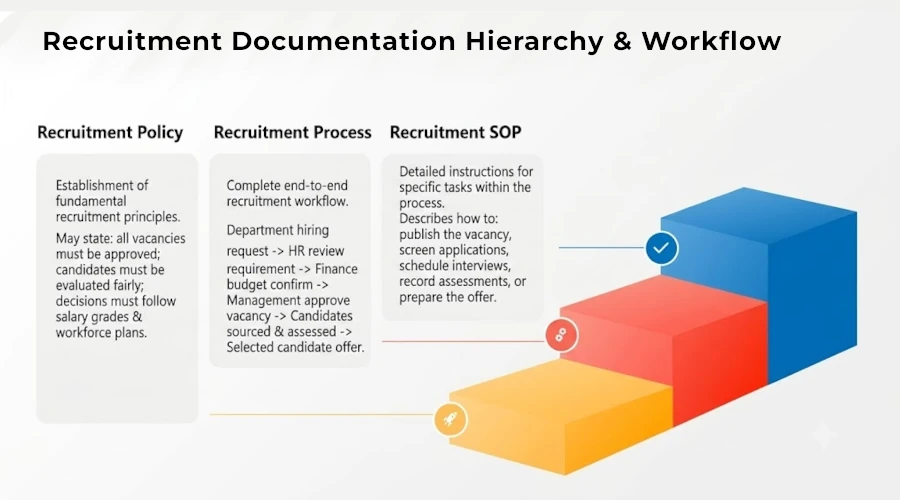
Policies, processes and SOPs should not be developed as unrelated documents. They work best as one connected management system. Let's look at an employee recruitment example for one of the companies in the Middle East. The recruitment policy may state that all vacancies must be approved, candidates must be evaluated fairly and employment decisions must follow approved salary grades and workforce plans.
The recruitment process then shows the complete workflow. A department submits a hiring request, HR reviews the requirement, finance confirms the budget, management approves the vacancy, candidates are sourced and assessed and the selected candidate receives an offer.
The recruitment SOP explains how an HR employee should complete a specific task within that process. It may describe how to publish the vacancy, screen applications, schedule interviews, record assessment results or prepare the employment offer.
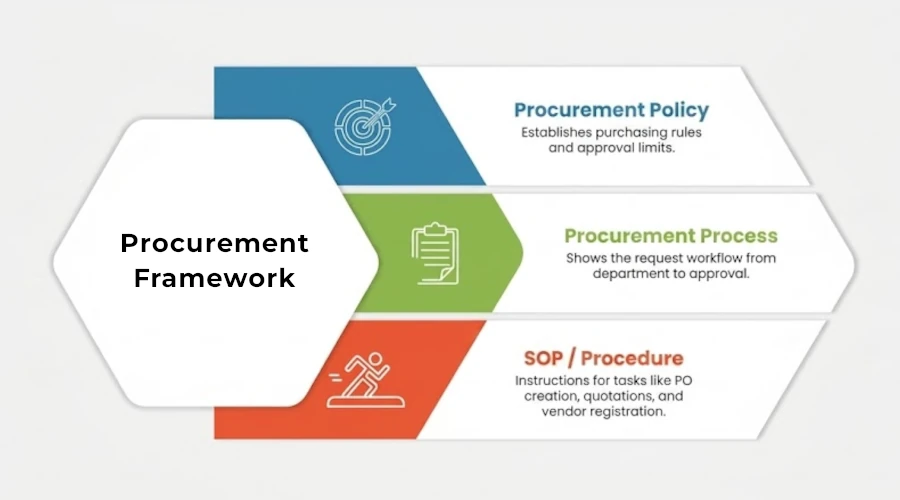
The same structure can be applied to procurement. A procurement policy establishes purchasing rules and approval limits. The procurement process shows how a request moves from the requesting department to procurement, finance and the authorised approver. The SOP explains how to create a purchase order, compare supplier quotations or register a vendor.
This connected structure creates consistency because employees understand both the organisational requirement and the practical steps needed to meet it. The elements may appear in separate controlled documents or within one integrated manual, depending on the organisation’s document architecture. It also improves accountability. When a problem occurs, management can identify whether the issue comes from an unclear policy, a poorly designed process, an incomplete procedure or instructions that employees cannot follow.
When Does a Company Need a Policy, Process or SOP?
Not every activity requires all three documents. The level of documentation should reflect the risk, complexity and importance of the activity. A company usually needs a policy when an activity involves legal obligations, financial authority, employee rights, ethical standards, data protection or significant organisational risk.
A company usually needs a process when work moves between several employees, departments or systems. Processes are particularly important when delays, duplicated effort, unclear ownership or excessive approvals are affecting performance.
A company usually needs an SOP when a task must be completed consistently, accurately and repeatedly. SOPs are especially useful for technical tasks, financial controls, customer service activities, employee administration and work that must continue during staff absence or turnover.
Warning signs that documentation is missing or ineffective include:
- Employees complete the same task in different ways.
- Approvals depend on personal relationships rather than defined authority.
- Work stops when one experienced employee is absent.
- New employees require excessive time to learn basic activities.
- Different departments disagree about responsibilities.
- Management receives inconsistent reports or inaccurate data.
- Customers receive different levels of service.
- Digital systems are introduced without redesigning the underlying workflow.
These issues often become more visible during growth, restructuring, digital transformation, regional expansion or the implementation of new ERP, CRM or HR systems. In such cases, documentation should not begin with writing. It should begin with an assessment of how the organisation currently works. This may require an organizational design and transformation review to clarify decision rights, reporting lines, role ownership and functional responsibilities before processes are documented. It may also require people advisory support to align job descriptions, accountability, performance expectations and employee capability with the redesigned way of working.

How Human Capital Consulting Develops Policies, Processes and SOPs
Effective business documentation should reflect how the organisation needs to operate, not simply describe outdated practices. At Human Capital Consulting, we begin with Organizational Assessments & Diagnostics. This allows us to understand the current structure, responsibilities, workflows, approval points, performance issues and operational risks.
The assessment may include management interviews, document reviews, process mapping, role analysis, workflow observation and discussions with employees who perform the work. This diagnostic stage helps identify where:
- Responsibilities are unclear or duplicated.
- Approval levels are excessive or inconsistent.
- Processes depend on individuals rather than systems.
- Policies do not reflect current business requirements.
- Existing SOPs are incomplete, outdated or difficult to use.
- Departments follow different versions of the same process.
- Workflow design creates avoidable delays, errors or costs.
Based on the findings, we support organisations through Policy & Procedure Development. Policies are written to provide clear governance, practical direction and defined authority without becoming unnecessarily complicated. Procedures and SOPs are then developed in a format employees can use. Depending on the activity, this may include step-by-step instructions, process maps, approval matrices, templates, forms, responsibility charts and exception-handling guidance.
Through Process & Operational Excellence, we also provide business processes optimization & workflow redesign. This means we do not automatically document the current process if it is inefficient.
Instead, we examine whether steps can be removed, approvals simplified, responsibilities clarified or activities automated. We then redesign the workflow before finalising the documentation. This approach helps organisations create documentation that supports faster execution, stronger controls and clearer accountability.
Depending on the scope, our work may include:
- Organizational assessments and operational diagnostics.
- Policy frameworks and policy manuals.
- Business process mapping and workflow redesign.
- Standard operating procedures.
- Approval and delegation-of-authority matrices.
- Roles and responsibility clarification.
- Process ownership and governance structures.
- Forms, templates and supporting documentation.
- Implementation guidance and employee orientation.
- Document control, review cycles and version management.
Good documentation should not create more bureaucracy. It should make work clearer, faster and easier to control.
For companies in the Middle East, structured policies and processes become increasingly important as the organisation grows across locations, functions and business units. They help management protect organisational knowledge, maintain service standards and reduce dependence on informal instructions. Most importantly, they create a clear connection between strategy, structure and daily execution.
Policies establish the rules. Processes organise the flow of work. SOPs make consistent execution possible.
Improve your policies, SOPs and business processes across the Middle East
