How 1-on-1 Meetings Can Improve Retention
in UAE, Saudi Arabia and Qatar

Anastasia Ivanovskaya
25 March, 2026
1-on-1 meetings are becoming more important in Gulf workplaces. In 2026, they are no longer just a recurring calendar slot between a manager and a direct report, made once a year. They are one of the simplest ways to improve retention, strengthen manager credibility, and give employees the support they often do not get from formal systems alone. For executive leaders in the UAE, Saudi Arabia and Qatar, that matters more than it may have a few years ago.
Work is moving fast. Teams are dealing with pressure, shifting priorities, restructuring, digital change, and higher expectations around growth. In that kind of environment, employees do not only need policies, surveys, or performance frameworks. They need regular manager attention. They need time to raise blockers, ask for context, talk about growth, and feel that someone is actually paying attention to how work is going. That is where a good one-on-one should take its place. And if you are a CEO or HR manager, who wants to encourage feedback culture and increase retention, this article is for you.
1-on-1 meetings are not only about updates. They are where feedback culture becomes practical, where trust is reinforced, and where employees decide whether this is a place worth staying in.
Why 1:1 Meetings Matter More in Gulf Workplaces Now
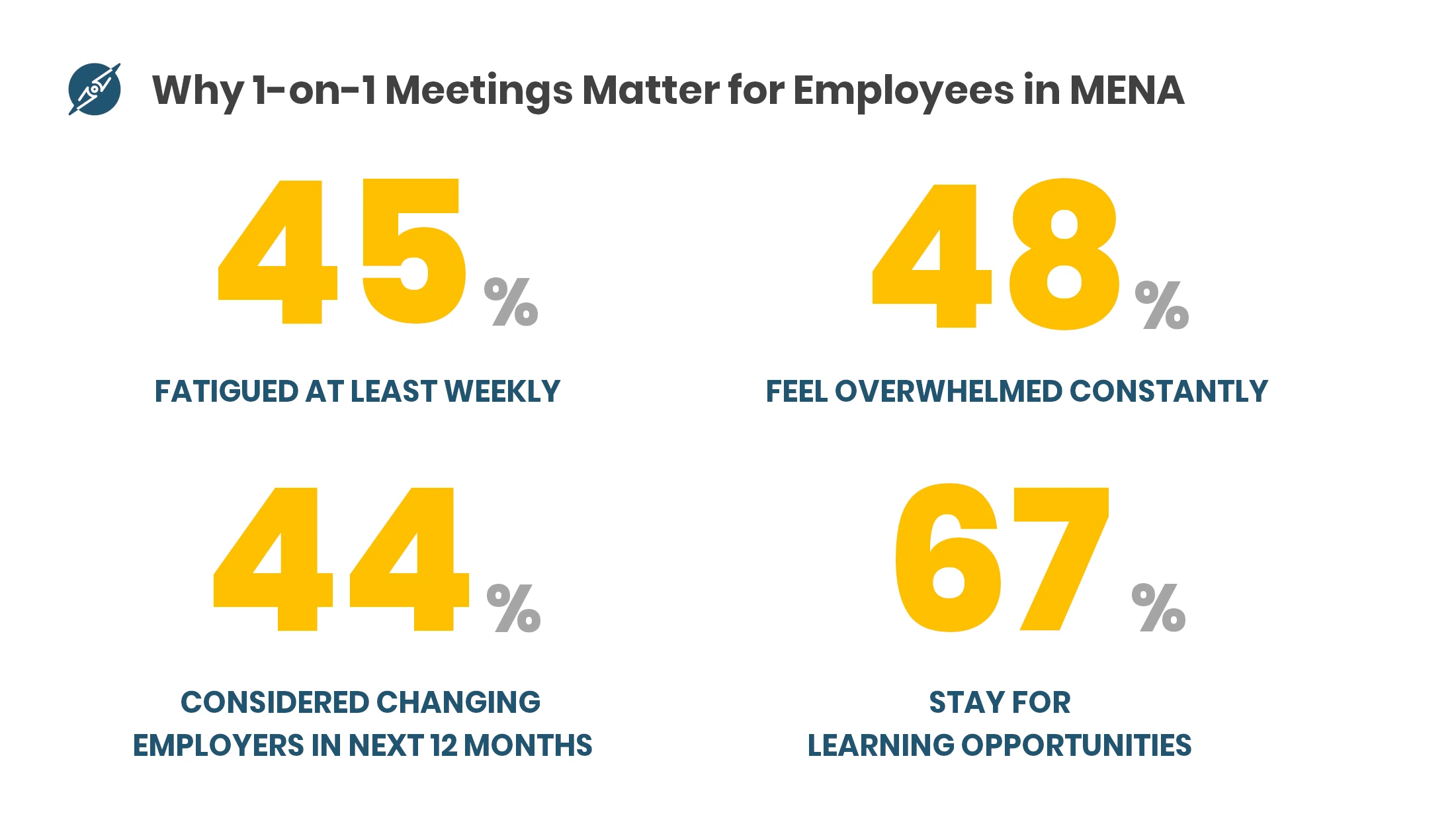
According to last year's PwC survey, 45% of employees feel fatigued at least once a week and 48% say they feel overwhelmed, compared with 35% globally. These are not abstract figures. They point to a workforce that is carrying pressure more regularly than many companies admit. In these conditions, manager contact stops being a "nice-to-have". It becomes part of how employees cope, stay aligned and decide whether the organization is worth staying with.
Retention challenge is also here. 44% of employees were considering changing employers within the next 12 months. Korn Ferry also reported that 80% of employees in the UAE and KSA would switch jobs for better pay. So yes, compensation matters. But pay is not the whole story. PwC study states that 67% of employees said opportunities to learn new skills influence whether they stay. That means growth, support and manager quality matter too.
Culturally Complicated Feedback Culture
A lot of international organizations talk about feedback culture. Fair enough, employee feedback matters. But in many Gulf workplaces, the deeper issue is not only a lack of feedback. It is how feedback is interpreted, delivered, and emotionally received. In high-context, relationship-driven business cultures, often seen across the Arab Gulf, direct criticism is frequently softened, delayed, or moved into private conversation because preserving respect and avoiding embarrassment matter a great deal.
Erin Meyer’s cross-cultural book "The Culture Map: Breaking Through the Invisible Boundaries of Global Business" draws a broader distinction between cultures that give negative feedback more directly and those that communicate it more indirectly. Business culture guidance for the UAE makes a similar point: criticism is often delivered subtly, in private, and with attention to hierarchy, trust and social harmony.
That can create a real challenge in international offices in Dubai or in foreign-invested companies in Riyadh and Doha. A European manager may believe they are being clear and efficient, while the employee may experience the message as unusually personal, harsh, or publicly exposing. The reverse can also happen. Managers and employees shaped by more indirect communication norms may avoid corrective feedback altogether, especially when hierarchy is strong or the relationship is still new. Guidance on Gulf business culture repeatedly points to relationship-based trust, high-context communication, and sensitivity around open disagreement as factors that shape how people speak up, challenge, or respond to criticism at work.
In the Middle East workplaces, relationship-based trust, high-context communication, and sensitivity around open disagreement shape not only how people give feedback, but whether they feel safe enough to speak at all.
Employees Do Not Only Need Feedback - They Need Manager Attention
48% of employees say their boss does not understand them or their job. At the same time, one in every 5 1-on-1 meetings is canceled. That combination tells its own story. One of the simplest ways to build enough trust for honest, culturally intelligent feedback is often treated as optional. That is exactly why CEOs, HR leaders, and line managers should take 1:1 meetings more seriously. In multicultural Gulf workplaces, these conversations are not just about performance updates. They are where managers learn how to give feedback without causing unnecessary friction, and where employees learn that correction is not rejection.
And when a 1-on-1 is skipped often enough, the message lands. This is not protected time. Your concerns are secondary. We will talk if there is space. That may not be what the manager intends, but it is often what the employee hears.
What 1-on-1 Meetings Actually Fix
Good 1-on-1 meetings do more than create a weekly touchpoint. They solve several management problems at once.
- Clarity - helps employees understand what matters now, what has changed, and where effort should go.
- Blockers - employees can raise roadblocks early, before they become delivery or morale issues.
- Development - these meetings create space to talk about growth, skills, and career direction, not only tasks.
- Trust - consistent meetings show that the manager is present, reliable, and willing to listen.
- Recognition - managers can acknowledge specific contributions directly, not letting good work disappear unnoticed.
This is one reason 1-on-1s connect so closely to retention. They support the parts of work that people remember long after the week ends - whether priorities were clear, whether someone helped when things got messy, whether growth was discussed, whether effort was noticed. Effective 1-on-1s support 3 layers of work at once: operational progress, relationship-building, and long-term development.
Why 1-on-1s Often Fail in Middle East Companies
The concept is not the issue. Most managers already know these meetings are useful. The problem is what usually happens around them.
One common issue is inconsistency . Meetings are booked, then postponed, shortened, or quietly dropped. That breaks continuity fast. A 1-on-1 works partly because it is predictable. Once the pattern becomes unreliable, trust drops with it.
Another common problem is turning the meeting into a status call . If the whole conversation is just a project update, then most of the value has been stripped out. Employees need room to talk about workload, context, support, learning, relationships, and what is getting in the way - not only what has been completed.
There is also the manager skill issue . Some managers are commercially strong, technically sharp, and operationally disciplined, but still uncomfortable with open-ended people conversations. They rush feedback, overtalk, jump into problem-solving too quickly, or avoid anything that sounds emotionally loaded. The result is a meeting that exists on the calendar but does not do much in practice.
And then there is hierarchy. In some MEA workplaces, employees may still hesitate to raise concerns openly, question direction, or ask for support directly. That makes the quality of the manager’s approach even more important. A 1-on-1 must feel like a safer conversation than the rest of the week. Otherwise it becomes another formal interaction where the employee says very little and leaves with even less.


Best Practice of One-On-One Meetings
A good One-On-One does not need to be complicated. It needs rhythm, attention and some structure.
It should be a regular schedule between weekly and monthly, ideally for 30 to 60 minutes. In practice, biweekly or monthly tends to work best for most roles because it keeps momentum without making the conversation feel excessive. The key is not choosing the "perfect" frequency. It is protecting a frequency that employees can trust. It's not your usual HoD or weekly meeting, don't mix it with daily routine tasks.
A strong 1-on-1 usually includes:
- A brief human check-in at the start.
- A review of priorities and current blockers.
- Discussion of support, development, or feedback.
- Clear follow-up actions before the meeting ends.
The best versions are shared, not manager-owned. Employees should be able to shape the agenda. They should know the meeting is there for them too. That changes the tone. It moves the conversation away from performance surveillance and toward useful problem-solving.
Managers should also listen more than they speak. You can estimate rough 70:30 listening-to-speaking ratio. Not because managers should stay silent, but because the most useful information usually appears after the employee has space to think out loud.
A 1-on-1 works best when the manager is not trying to control the conversation, but trying to understand it.
Why Arab CEOs and HR Leaders Should Care
It is easy to treat 1-on-1s as a line manager issue only. That would be a mistake. They are also a business design issue.
If workloads are rising, if development matters to retention, and if managers are the main point of contact between company systems and employee experience, then the quality of 1-on-1s becomes part of overall business performance. It affects clarity, pace, escalation handling, retention risk, and the employee’s sense of whether the company is serious about people leadership.
This is especially relevant in the GCC now. Employees are not only asking whether the company pays well. They are asking whether they are learning, whether their manager helps, whether their concerns go anywhere, and whether someone notices when work gets difficult. In many UAE workplaces, where European, Arab and Indian professionals often work side by side, feedback culture and formal 1-on-1 meetings are still developing as a management habit. Different expectations around hierarchy, criticism, and respect can make feedback feel more personal or make managers avoid it altogether, which is exactly why regular manager conversations matter so much. Those answers do not live in a policy. They show up in recurring manager conversations.
So for CEOs and HR leaders, the question is not simply, "Are managers holding 1-on-1s?". The real question is: "Are these meetings consistent, useful, and strong enough to support retention?"
How Human Capital Consulting Can Help
1-on-1 meetings look simple on the surface, but the problems underneath them are often much bigger. A company may assume it only needs manager training. Sometimes that is true. But very often the issue is in the operating model itself: unclear role expectations, overloaded managers, weak team visibility, poor listening habits, cross-cultural misunderstandings, or performance systems that reward delivery while ignoring people leadership.
At Human Capital Consulting, this is exactly the kind of challenge we help organizations address across the Middle East. Through People Advisory, companies can strengthen role clarity, managerial expectations, performance management, competency frameworks and leadership development - all of which improve the quality of 1-on-1 conversations.
Businesses can build stronger managerial skills in active listening, feedback delivery and employee development, with our Talent Acquisition & Workforce Development consulting services.
And where the issue is workflow pressure, duplicated approvals, or operational friction that leaves managers stuck in firefighting mode, Process & Operational Excellence can help redesign how work moves across teams.
That is the real point: 1-on-1s do not improve just because a company tells managers to hold them. They improve when the organization gives managers the structure, skills, time, and cultural awareness to make those conversations useful - especially in multinational offices across Dubai, Riyadh, and Doha, where communication styles, hierarchy, and expectations around feedback may differ sharply across teams.
1:1s Are Not Admin - They Are a Management Operating Habit
A 1:1 meeting can look almost too simple to matter. One manager. One employee. A regular conversation. That is it.
But inside that simple structure there is a surprising amount of value: context, trust, recognition, coaching, development, course correction and early warning signals. Miss those conversations for long enough, and small issues stay hidden until they become expensive. Hold them well and consistently, and people usually feel more stable, more supported, and more likely to stay.
That is why one-on-ones should not be treated as administrative upkeep. They are part of how a company runs. In UAE, Saudi Arabia, and Qatar, where pressure is high and retention is getting harder, this may be one of the most useful management habits to strengthen in 2026.
References
- PwC Middle East. (2025). Workforce Hopes and Fears Survey 2025
- PwC Middle East. (2024). Workforce Hopes and Fears Survey 2024
- Korn Ferry. (2025). How Are Workforce Priorities in UAE and Saudi Arabia Shifting?
Train managers who can hold better 1-on-1s, give feedback well and reduce avoidable turnover