How Middle East Managers Can Use Recognition
to Improve Retention in 2026

Anastasia Ivanovskaya
17 March, 2026
Employee recognition is no longer treated as HR topic only. Company recognition is much closer to retention, manager credibility, team performance and execution stability. For CEOs, top managers, HR managers and CHROs, the issue is not whether appreciation matters. It does. The real question is whether managers know how to use recognition in a way that helps people stay, contribute and keep going when the pressure rises. That matters in in the Middle East region, where fatigue, mobility and rising employee expectations are all part of the current workforce picture.
PwC’s Middle East Workforce Hopes and Fears Survey 2025 found that 45% of employees feel fatigued at least once a week. Its regional findings showed that 44% were considering changing employers within the next 12 months. Korn Ferry also reported that 80% of employees in the UAE and Saudi Arabia would switch jobs for better pay. Recognition will not replace salary, sound structure, or a good manager. But it does bring something that companies underestimate all the time: whether people feel noticed, respected, worth staying for.
Recognition is not a side issue. It is one of the clearest signals a manager can send about what and who the company truly values.
Why Employee Recognition Affects Retention More Than Managers Think
People rarely leave for one reason only. Compensation may be part of it. Workload may be part of it. Weak leadership, vague expectations, or limited growth may be the issues why employees quit. Then there is another factor, less dramatic, but dangerous: the growing sense that their effort is invisible.
That is where recognition becomes a business issue, not just a company culture issue.
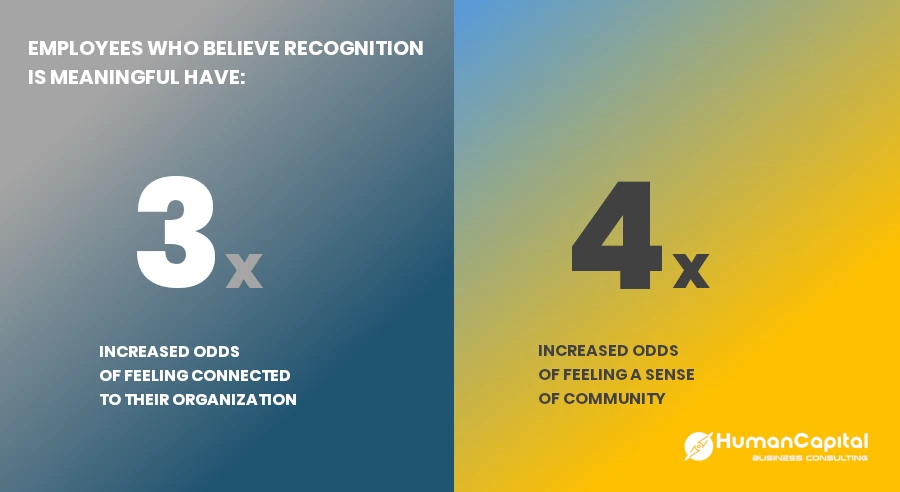
79% of people who quit mention lack of appreciation as a reason for leaving, while employees who receive consistent recognition are more likely to stay an additional period of 3.5 years. Organizations with integrated recognition are also 4x more likely to have highly engaged employees. Employees who believe recognition is meaningful have 3x increased odds of feeling connected to their organization and 4x increased odds of feeling a sense of community.
Annual Awards Do Not Fix Retention
Many companies still handle recognition like a formal event. Once a year, a stage, a few certificates, some applause, a nice photo, and that is that. It looks polished, but it does not change everyday manager behavior. And everyday manager behavior is what employees actually live with.
Here is the useful part: best practices state that recognition needs to happen weekly or every other week to become effective and part of culture. So the conversation changes. Recognition is not a once-a-year celebration. It is an ongoing management discipline.
That difference matters. A lot.
What Managers Should Actually Recognize
A common mistake is saving recognition only for major wins. Big client or important launch. Big target achieved. Of course those moments deserve attention. But if recognition only appears after headline results, most of the employee experience goes unnoticed.
Stronger managers recognize a wider range of contribution:
- Everyday effort - helping beyond role scope, supporting colleagues, staying steady under pressure.
- Small wins - progress on a project, smart collaboration, solving a blocker before it grows.
- Big wins and standout results - exceptional contribution, innovation, strong commercial or delivery outcomes.
- Learning and development - not only certification, but visible growth in skills and judgment.
- Career milestones and transitions - promotions, new roles, anniversaries, and meaningful work moments.
- Team success - because retention is social as well as individual.
PwC’s 2024 Middle East findings showed that 67% of employees said opportunities to learn new skills influence their decision to stay. So when managers recognize learning effort and adaptability, they are reinforcing one of the region’s clearest retention drivers.
Generic Praise Fades Fast - Specific Recognition Sticks
"Well done." "Great job." "Thanks for the support." There is nothing wrong with these phrases, but on their own they are too thin. Employees can tell when recognition is automatic. They can also tell when it comes from real attention.
Meaningful recognition is more specific. It says what the person did, why it mattered, and who it helped. Employees respond more positively when recognition shows how they made a difference at work and demonstrates that their contributions are valuable.
So instead of saying:
"Great work on that client/project."
A better manager says:
"The way you handled that client escalation kept the relationship stable and helped the team avoid a bigger issue. You were calm, fast and thoughtful, and that made a real difference."
Same purpose. Very different impact.

Recognition & Manager Credibility Go Together
Recognition is not mainly about a reward. It is about what the moment communicates. Does it show that the manager notices? Does it show that effort is visible? Does it show that contribution counts?
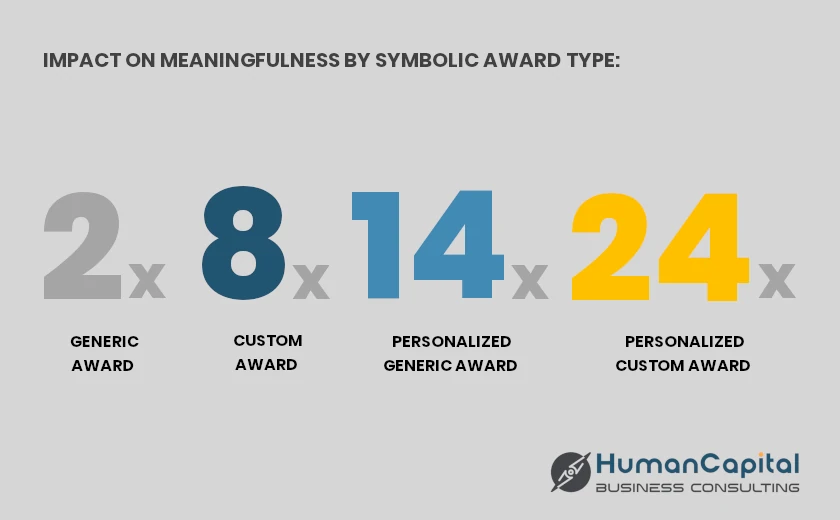
That is why recognition has such a strong effect on manager credibility. There is 52% increase in meaningfulness when recognition conveys that the leader knows the employee.
And when that feeling is missing, the damage is quiet but real. Recognition starts to feel empty. The manager starts to feel distant. Retention starts to weaken.
Employees do not stay only because they are thanked. They stay where contribution feels visible, leadership feels real, and effort does not disappear into silence.
AI & Written Recognition Texts
AI is creeping into nearly everything - writing, reporting, workflows, internal communication, manager prompts. Recognition is no exception.
Recent reports say that 55% of employees believe AI can improve the recognition experience, and nearly 60% believe it can help them create better recognition messages. At the same time, 63% fear AI will make recognition less personal.
That anxiety and tension make complete sense. AI can help managers draft, remember, or structure recognition moments. But if the message sounds flat, generic, or suspiciously polished, the impact drops fast. Recognition should be tech-supported, not machine-automated.
In Middle East companies moving quickly on AI and digital workflows, that balance matters. When work becomes more digital, recognition needs to become more intentionally human - not less.
Why This Matters for Executives
If retention is a boardroom concern, recognition cannot be left to personality or chance. It should not depend on which manager is naturally expressive, socially confident, or unusually thoughtful. It needs structure, guidance and reinforcement. And feelings to be put into words.
That means executive management should ask a few uncomfortable but useful questions:
- Do our managers know how to recognize contribution well?
- Does recognition happen often enough to matter?
- Is recognition fair across teams, functions and levels?
- Does recognition reflect what the business truly values?
- Does it feel human, or does it feel like a process artifact?
These are not easy HR questions. They are management questions.
How Human Capital Consulting Helps
At Human Capital Consulting, we believe that recognition works best when it is not random. It needs support from the wider people and operating model.
This is the kind of issue we help companies address across the Middle East. Where the real challenge is weak reporting lines, vague managerial accountability, or team structure, our Organizational Design & Transformation services help companies build stronger management environments. Where retention, motivation, and employee value proposition need attention, our Rewards, Compensation & Engagement services are directly relevant. And where companies need stronger capability from the start, our Talent Acquisition & Workforce Development work supports onboarding, manager readiness and long-term workforce growth.
In other words, recognition is not separate from how a company is designed, how managers operate, or how talent grows. It is already inside all of that.
Retention Gets Stronger When Contribution Feels Visible
People do not stay only because they are praised. It is not that simple.
They stay where effort is noticed. Where progress is acknowledged, where managers pay attention. Where their contribution has weight. Where the company culture does not feel emotionally blind.
That is what recognition, when done well, reinforces and motivates.
So yes, salary, role design and leadership quality matter. However, employee recognition still deserves a central place in the retention conversation - not as an automated message, but as one of the clearest signals a manager can send.
References
- O.C. Tanner Institute Employee Appreciation and Recognition and State of Employee Recognition 2025.
- PwC Middle East (2025). Workforce Hopes and Fears Survey 2025 .
- PwC Middle East (2024). Workforce Hopes and Fears Survey 2024 .
- Korn Ferry (2025). How Are Workforce Priorities in UAE and Saudi Arabia Shifting? .
Need stronger retention, manager capability & people systems that actually support performance?